

Today, February 15th, marks the centenary of the inaugural session of the Permanent Court of International Justice at The Hague. Bill Bowring explores how international justice has operated since then.
What do we have to celebrate in 100 years of international justice? How should we evaluate Labour’s key role in its founding and continuation?
The Permanent Court of International Justice (PCIJ) was the Court of the League of Nations. The League originated in proposals before WWI, in the 1907 Hague Conference, but became a reality when the League was founded on January 10th 1920 at the Paris Peace Conference which ended the war. The League had 44 states at its start, 31 of which had been allies of Britain, France and the USA. It was the first worldwide intergovernmental organisation. At its peak in 1934-5 it had 58 members, but the USA never joined, and the USSR joined in 1934 only to be expelled after invading Finland.
Of course, most of the planet, with the exception of South America which had already broken free from Spain and Portugal, was ruled by Britain, France and the other European colonial powers. The battle for decolonisation raged through the decades after WWII, and has not yet been completed. All round the world there are peoples with a right to self-determination – the right which had its origins with Marx, Engels and Lenin – which they are still denied.
In 1920 the Council of the League of Nations organised the drafting of the Statute of the PCIJ, which was able to move into the grand Peace Palace in The Hague, constructed in 1913 before WWI. The first session of the PCIJ took place from January 30th to March 24th 1922, with a formal opening on February 15th.
Despite its abject failure to prevent war, the League persisted until 1946, when it had already been replaced by the United Nations, founded on October 24th 1945. The PCIJ continued as the UN’s International Court of Justice (ICJ), which still resides in the Peace Palace, and also inherited the Statute with its dated language (“civilised nations”, etc.).
What was Labour’s attitude? Through the efforts of Arthur Henderson and Ramsay MacDonald, the Keir Starmers of their day, the Labour Party endorsed the idea of a League of Nations at a special conference in December 1917. The Party’s 1918 programme Labour and the New Social Order demanded that a “Universal League or Society of Nations” be established. At another Special Conference in April 1919 they accepted the provisions under which nations in dispute would be obliged to refer their difference to the League’s court.
In its 1928 programme Labour and the Nation, Labour pledged to use the PCIJ, and as Foreign Secretary in MacDonald’s second minority Labour Government of 1929-31, Henderson signed an Optional Clause extending the jurisdiction of the PCIJ to all legal disputes involving Great Britain.
Labour’s programme in no way challenged the existence of the British Empire, or the barbarism and bloodshed through which it was defended.
The dominant view of the progressive radicalism of the postwar Attlee government of 1945-1951, must be revisited against the brutality of its imperial adventures. At the end of WWII, the Labour government found itself involved in three military interventions, in Indochina, Indonesia and Greece, all initiated while Labour had been in coalition with the Conservatives, but now enthusiastically continued. The welfare state was accompanied by the creation of the warfare state. It was the Labour Party which cemented the ‘special relationship’ with the United States, and Attlee and Labour played a central role in 1949 in establishing NATO. In the 2019 election, Labour confirmed its support for NATO and for the UK’s financial contribution.
Nevertheless, the ICJ has flourished, with some progressive decisions. In 1986, Nicaragua won its case against the USA, over its support for the Contras and other actions. In 1995 the ICJ ruled on the possession and use of nuclear weapons, in an Advisory Opinion which continues to cause problems for nuclear missile submarine commanders. In 2004 it ruled on the illegality of Israel’s Wall in the Occupied Palestinian Territory. And in 2019 it lambasted the UK for its violation of the right to self-determination of Mauritius, when, by duress, it kept the Chagos Islands, and handed Diego Garcia to the USA for its notorious base.
The Human Rights Committee of the UN hears complaints against UN states for individual violations, and there are now three regional courts – the European Court of Human Rights, the Inter-American Court of Human Rights, and the African Court of Human and Peoples’ Rights – under which individuals and groups can complain against governments. Britain has never accepted the European Convention on Human Rights, despite its being the brain-child of Winston Churchill. Theresa May saw it as a terrorists’ charter. The UK ratified it in 1953 but only allowed complaints to be brought under it in 1966, and immediately suffered several defeats over colonial issues, and only brought it partially into UK law in the Human Rights Act 1988.
The Labour left, initially sceptical about the ECHR because it would give too much power to judges, now defends it against the Tory onslaught.
International Criminal Justice made a shaky start with the creation by the UN Security Council of the International Criminal Tribunals for Yugoslavia and Rwanda, prosecuting individuals for the crime of Genocide, Crimes Against Humanity and War Crimes. The International Criminal Court was created in 1998 after a huge campaign by NGOs, and 123 states have ratified its Rome Statute. It is weakened by the fact that the USA, India, Russia and China have not signed up. But after a start dogged by double standards, and an exclusive focus on Africa, the outgoing Prosecutor, Fatou Bensouda, has broadened its remit, now to include was crimes committed in Palestine.
So it would be far too early to write off the whole of international justice. And for a socialist lawyer like myself it provides opportunities for useful legal work, in my case representing Kurdish and Chechen victims.
Bill Bowring, Colchester CLP, teaches international law and human rights at Birkbeck College. He is International Secretary of the Haldane Society of Socialist Lawyers and President of the European Lawyers for Democracy and Human Rights (in 21 European countries).
Buy my book in Russian electronically with 10% discount.
Bill Bowring: Is Russia a European country?

6 September 2021
by Bill Bowring, Professor of Law at Birkbeck College, University of London, where he teaches public international law, human rights and minority rights. https://www.rightsinrussia.org/bowring-2/
It is too often asserted that Russia is not a “European” country: not necessarily by the Brexiteers who are certain that Britain is not European either, but “global”.
True, from 1237 to 1480, with the battle known as the Great Stand on the Ugra River, what is now Russia paid tribute to the Mongol-Tatar Horde. For a graphic depiction of what this meant, see Tarkovsky’s great film Andrei Rublev. The tribute was paid with regular visits to the Tatar capital in the steppe (better for horses), and Russian rulers intermarried with the Tatar elite. To this day the Russian language has many Turkic – the Tatar language, the historic tongue of 5 million Tatars in Russia, is Turkic – words, for important things, especially in the 13th to 15th centuries, like horse (loshad), kazak, guard (karaul), treasury (kazna), money (denga), brick (kirpich), watermelon (arbuz), shoe (bashmak), etc
For the rise of Moscow, Eisenstein’s Ivan the Terrible cannot be bettered. Only 50 years after the defeat of the Tatars, Ivan IV became ruler of Moscow in 1533, of Russia in 1547 and in 1552 conquered Kazan, now the capital of Tatarstan, razed the Qul Sharif Mosque (now splendidly rebuilt) to the ground, and constructed St Basil’s cathedral in Red Square to celebrate.
However, Ivan did not only look eastwards. In 1570 he was furious (the letter is on the internet) when Queen Elizabeth I rebuffed his offer of a strategic marriage: England was building a maritime empire, Moscow a continental empire. Serious trade between England and Russia had begun with the Muscovy Company in 1551.
Indeed, Britain and Russia have been on the same side of every serious war – Napoleon, WWI, WWII – since then. Alexander I marched all the way to Paris in 1814, defeating Napoleon on the way, with generals named Barclay de Tolly (Scots/German) and Wittgenstein. The exception is the Crimean War (1853-1856), and no student, English or Russian, can tell me what this war was about. Britain and Russia did not even come to blows in Central Asia, and both failed to conquer Afghanistan. Britain lost a whole army at Kabul in 1842.
The greatest Tsar of Russia was Catherine II, a German princess, there are even more German family names than Scots and Welsh. Many Russians have the family names Gordon, Hughes, Williams – Scots and Welsh who built the railways, married Russians and stayed.
I’m a lawyer. The founder of law as an academic discipline in Russia, Semeon Desnitsky, spent six years in Glasgow, studying constitutional law under Adam Smith, and becoming Catherine’s chief legal adviser. In the mid 19th century Russian civil law was based on German law, and restored in the NEP period after 1917; Alexander II initiated jury trial on the English model, an independent bar, and “justices of the peace” in 1864, all restored since 1991; the present Civil Code was drafted with Dutch experts, the Constitutional Court of the Russian Federation is based on the German Verfassungsgericht in Karlsruhe. Russia is a member of the Council of Europe since 1996 and party to the ECHR since 1998.
Russia is not European? Then neither is Britain, the latter suggestion being more convincing.
Bill Bowring, Professor of Law, University of London, Barrister of England and Wales, President of the European Lawyers for Democracy and Human Rights.
We are here to commemorate the tragic death in prison of Ebru Timtik, on hunger strike in protest against the absence of a fair trial for her in Turkey. She was a brave fighting lawyer.
Here is my answer to the question for this session.
I am a revolutionary socialist who happens to have become qualified as a lawyer. I seek to use my skills as far as possible in the class struggle, especially struggles for self-determination. I have written a lot about this.
So my own history might be of interest, to show what I mean.
I did not qualify at first as a lawyer. When I was 16-17, already a communist, I worked on a small cargo ship around West Africa and the East Coast of the USA. This opened my eyes to the reality of European colonialism in Africa, and I participated in New York in the March of a Million against the Vietnam War.
The following year, 1968, I was a protestor against the Vietnam War, at the Democratic Convention in Chicago, as a member of the Students for a Democratic Society (SDS).
My degree from 1967 to 1970, at Kent University, was in Philosophy. I was a revolutionary socialist, first in the Revolutionary Socialist Students Federation, and for a period in 1972, the high point of the class struggle in England, I was a full time revolutionary in the Workers Revolutionary Party, organising coal miners.
In England it is possible to qualify as a lawyer in just two years, which I did from 1973-1974.
I lived for 15 years in Brixton, South London, from 1974, and served as a volunteer adviser in the Brixton Advice Centre. I was “called to the Bar” in 1974, and in my first cases as a barrister I represented housing squatters, and campaigned against the proposed law criminalising squatting.
In 1978 I was elected as a Labour Councillor in Lambeth which includes Brixton. There were several black councillors, and a black Mayor.
I was involved in the Brixton Riots in 1981, when Brixton was under a state of siege from the police, and in 1985 when the police shot a black woman in bed.
In 1986 I and my Council colleagues were prosecuted by Mrs Thatcher for “wilful misconduct”, for taking illegal action against her policies, fined £160,000, and banned from holding public office for 5 years. We raised the money through the Labour Party and trade unions.
Since that time I have been active in the Haldane Society of Socialist Lawyers.
From 1986 to 1990 I represented victims of police misconduct: wrongful arrest, false imprisonment, torture, malicious prosecution. These cases were mostly cases of racist attacks on black people and the working class.
In 1988 I was sent on a mission to Palestine, and first saw the relevance of human rights law and the law of armed conflict. I have returned to Palestine many times.
Since 1991 I have been closely involved in the struggle against the British occupation of Northern Ireland, in the armed conflict which lasted from 1969 to the 1998 Good Friday Agreement. Marx and Engels strongly supported the fight for Irish independence. I fight for the reunification of the Island of Ireland.
I began teaching, at the University of East London, in a working class district, in 1990. Starting in 1992, I worked as a volunteer with the Kurdish Human Rights Centre, and represented Kurdish applicants at the European Court of Human Rights: Özgur Gundem v Turkey, Aktas v Turkey, ipek v Turkey and many others. Since 2000 I have been representing Chechen and other victims of Russian violations of the ECHR.
I agree with Marx and Engels that there can be no socialist law, nor can there be socialist legal theory. The law is made by the capitalist state, and is an instrument of the ruling class in the class struggle.
Workers can and must, however, advance legal demands. In their time this was the fight for a ten hour day, to be enforced by law. To do this they need the services of competent lawyers
In my opinion lawyers cannot be a revolutionary vanguard, but there can be revolutionaries who are lawyers, just as there can be revolutionaries who are accountants, or doctors. Or even capitalists, like Engels. But I am not sure what a “revolutionary lawyer” would be. Probably a bad lawyer.
The workers or any people involved in struggle against capitalism, or suffering persecution or injustice, may need a competent lawyer. That is what we try to offer in the Haldane Society. We played a particularly important role in the Great Miners Strike of 1984-5. Now we are involved in many struggles – there is resistance all over Britain.
But I don’t think law can be transformative or emancipatory. That is the role of the working class in the class struggle. Lawyers are competent technicians, serving the working class.
The reception or the lack of it, of the concepts of Rudolf von Jhering in the English speaking world
Outline of Bill Bowring’s presentation
Ivanovo State University, Russia, 25 September 2020
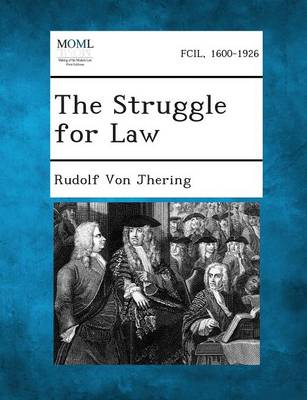
- There are only two translations of Jhering’s work in English. Jhering’s masterpiece, Geist des römischen Rechts (The Spirit of Roman Law) 1852–1865, in two volumes has never been translated. The two translations are Der Kampf ums Recht (1872) and Der Zweck im Recht (1877–1883).
- Both were published in the USA, the first as The Struggle for Law, translated from the 5th edition by the attorney John J. Lawlor, and published in Chicago in 1879. There is a facsimile edition published in 2017. The second was published as Law as a Means to an End, translated by Isaac Husik, and published in New York in 1913, with a reprint in 1968. This is hard to find.
- Nevertheless, I have found at least 20 scholarly articles in English in which Jhering is mentioned, and in some of which his work is discussed in detail.
- What is the nature of Jhering’s contemporary reception? And why have the two English translations appeared only in the United States?
- The reason is to be found in an article published in 2012 in the Tulsa Law Review, by three scholars at the University of Connecticut and Fordham Schools of Law, Julie Grisé, Martin Gelter, and Robert Whitman. Their article is entitled “Rudolf von Jhering’s influence on Karl Llewellyn”, that is, Jhering’s influence on the American Realist Legal School. Karl Llewellyn (1893 to 1962) was fluent in German, and indeed fought on the German side in WWI, winning an Iron Cross. He is best known for The Bramble Bush: On Our Law and Its Study, 1930, republished in 2009 by OUP.
- This school no longer dominates US jurisprudence, but the authors cite President Obama, a lawyer, in 2009 in relation to an appointment to the Supreme Court: “Iwill seek someone who understands that justice isn’t about some abstract legal theory or footnote in a case book, it is also about how our laws affect the daily realities of people’s lives, whether they can make a living, and care for their families, whether they feel safe in their homes, and welcome in their own nation.” Realism!
- What was this influence?
- First, according to the authors of the article, was Jhering’s crusade against conceptual jurisprudence – his campaign against the use of “heavenly concepts” to solve real problems, and juristic work driven by purpose, not invisible concepts. For Jhering, the life of the law was experience, not logic: law had to be functional.
- Second, Llewellyn leaned about purposive interpretation from Jhering. The language of a statute was relative, not absolute, must be understood in terms of its context: law was a means to preselected social ends.
- Third, Llewellyn’s views on the judicial function – that law is merely a prediction of what the courts will really do.
- The American Realist School has in turn had a profound influence on Critical Legal Studies, which remains a major school of jurisprudence in the US and UK.
- One aspect of this is the “indeterminacy thesis”, which emerged as a left-wing reply to Ronald Dworkin’s contention that there is a “right answer” to each legal problem. In its strongest form it is an extreme version of legal realism. It argues that nothing is law until it has been promulgated by an official – either a judge or the legislature.
- Duncan Kennedy of Harvard Law School is a leading Critical Legal scholar. In an article published in 2000 in the Colombia Law Review, on Lon Fuller, placing Fuller’s analysis of contract questions in the context of the critique of the 19th century will theory of contracts, and the rise of sociological jurisprudence and legal realism.
- In a footnote Kennedy says: “Between 1972 and 1975, I read Rudolf von Jhering’s The Spirit of Roman Law (in French translation) because Fuller had cited it. Jhering’s seemed to me a much better, indeed an unutterably brilliant, take on the issues Fuller discussed, and this greatly reduced my admiration for Fuller. My article downgrades him for this reason.”
- Interest in Jhering is not only to be found in the US. In 2009 Neil Duxbury, now Professor of English Law at the London school of Economics, published an article in the prestigious Oxford Journal of Legal Studies entitled Jhering’s Philosophy of Authority. His starting point was that during the 20th century Anglo-American legal philosophers saw Jhering either as the German forerunner of American legal realism, or as an early proponent of a jurisprudence of interests. In Duxbury’s view Jhering’s goal was rather to explain how legal systems originate, and how they maintain authority. His originality was in the concept of Rechtsgefühl, that authority depends on citizens’ feelings of what is right and just. He believed that the authority of a legal system depends on its ability to negotiate and accommodate struggles based on feelings of right. Struggles between citizens, between citizens and the State, and between States.
- My curiosity was aroused by the following.
- In the Kampf, Jhering is full of praise for the “combative Englishman” – “the typical figure of the travelling Englishman who resists being duped by inn-keepers and hackmen, with a manfulness which would induce one to think he was defending the law of Old England.. For, in the few shillings which the man here defends, Old England lives.” (p. 62) and later “in the shilling he stubbornly defends the political development of England lives.” (p.94) All of this is to illuminate the “healthy feeling of legal right”.
- In the Zweck, I noted Jhering’s powerful critique of the liberalism of John Stuart Mill (p 403 to 409), having denounced socialism and communism as “vain folly” (p.396) and referred to “so-called class struggle” p 410. To me the Zweck seems curiously detached even from the world of the second half of the 19th century, and most references are to Roman law.

Igor Shoikedbrod has given us a strongly argued and rigorous engagement with Marxist theory, which is – in the opinion of this reviewer – a great pleasure to read, and from which there is much to learn. However, the title is perhaps misleading. Marx never provided a critique of liberalism as such, as a political ideology. I will turn finally to what Marx thought of Liberals, or Whigs as they were then called.
In my view the title to Chapter 5, “Contemporary Responses to Marx’s Critique of Liberal Justice” gives a much better idea of what the book is about. This chapter contains incisive and powerful critiques of some leading contemporary theorists of liberal justice: John Rawls (141-150), Jürgen Habermas (150-159), Axel Honneth (159-169), Nancy Fraser (169-173). As Igor points out, Marx’s journey from philosophy to law “formed the basis for his critique of formal liberal justice” (173). And these four scholars “have tried either to respond directly to Marx’s critique or to modify his critique in the light of the challenges presented by global financial capitalism.” (173)
Igor, however, goes further than explicating Marx’s “critique of formal liberal justice”. He has a much bolder claim, which provides the backbone to his book: that a “major premise” of the development of Marx’s materialist theory of history was his “new materialist conception of right” (Igor’s emphasis, 34). On the following page Igor explains that this is “historically situated and is based on the view that different standards of right apply in different modes of production”. Igor has chosen to translate the German Recht as “right”, meaning a system of law and justice (2); “rights” would be Rechte. He is quite right not to translate Recht as “law” or “the law”. “Law” and “the Law” are the subject of considerable mystification, even partially concealed veneration, by many “critical legal” and, in particular, “post-modern” scholars. Law is given a status and significance which, for Marx and Engels, it simply did not deserve.
It should be noted that Marx wrote a “critique of political economy”, and on no account a “theory of economics”; and most certainly did not attempt a theory of law. Indeed, in 1843-4 he wrote his Critique of Hegel’s Philosophy of Right, which acknowledges the power of the young Hegel’s critique of capitalist relations (Lukács), while showing how Hegel could not arrive at a materialist diagnosis or recognition of the class struggle.
Igor demonstrates a splendid knowledge of the Grundrisse, Capital, and many other texts by Marx and Engels, and their critics. But there is one important text which does not appear in his book, surprisingly. In 1887, a few years after Marx’s death, Engels and Karl Kautsky published their article Juristen-Socialismus, translated into English and published as “Juridical Socialism” (Engels and Kautsky 1977, see also Beirne 1977). Engels explained – and Marx would not have disagreed – how the main battle cry of the bourgeoisie became “equality before the law”, because their struggle had to be based around legalistic demands. “This solidified a world view based on legal rights … at first the proletariat had embraced the world view of legal rights, and sought weapons in it for use against the bourgeoisie.” Engels and Kautsky insisted that “Marx … presents no legalistic demands at all in his theoretical work … Legal rights, which always reflect the economic conditions of a specific society, are treated only in a very secondary manner in Marx’s theoretical studies, as opposed to the primary historical topic of situating particular circumstances, means of acquisition, and social classes in specific periods.” But they also insisted that socialists would not fail to present certain legalistic demands: “Every struggling class must therefore formulate its demands as legalistic demands within a program … however, no existing socialist party has thought of making a new legal philosophy of its program, and this will not happen in the future.” For example, the workers’ struggle for the ten hour day, which occupies a significant part of Capital.
This position was paraphrased by Peter Schöttler in 1993 as follows: “… there is indeed no proletarian or socialist legal ideology (just as there can be no socialist philosophy of law), but there are proletarian, or socialist, legal demands, and these are necessary, nay indispensable, if the proletariat wishes to articulate its interests politically in opposition to the bourgeoisie and the bourgeois state. The political class struggle includes making legal demands.” In fact, Engels and Kautsky – and Marx – provided the strongest support for Igor’s position.
There are at least 13 references in Igor’s book to “Marx’s new materialist conception of right” (33, 35, 38, 43, 47 x 2, 85, 88, 137, 138, 208, 213, 214) – more than appear in the Index, which is rather incomplete. In my view this is what the book is really about – that is, the critique of right, or in other words, formal bourgeois or liberal justice. And this is based on Marx’s new materialist conception (not theory) of right.
Chapter 4 is entitled “The Normative Argument for Communist Legality”. Again, the title is perhaps misleading, since this chapter contains to my mind the best critique – indeed demolition – of the “commodity exchange theory of law”, better known as the Commodity Form Theory or CFT, of Evgeny Pashukanis.
Contemporary “Pashukanists” include China Miéville, Robert Knox, and Grietje Baars (see my 2020 review in Marx & Philosophy Review of Books of her monumental The Corporation, Law, and Capitalism, a thoroughly Pashukanist work).
Pashukanis worked out the most rigorous and interesting attempt at a Marxist theory of law, his General Theory of Law and Marxism, in 1920-21 in Berlin while employed as the legal adviser to the Soviet Russian delegation negotiating the Rapallo Treaty with Germany. He wrote it in 1923. The General Theory was published in Russia in 1924. Of course, 1921 was the year in which Lenin introduced the New Economic Policy, described by him as an “economic system that would include ‘a free market and capitalism, both subject to state control,’ while socialized state enterprises would operate on ‘a profit basis’.” After Lenin’s death, Stalin changed course dramatically in his “great break” of 1928.
As Igor notes, “Although Pashukanis grants that recourse to law will still be necessary during the transition from capitalism to communism, he leaves no doubt about the withering away of law in developed communist society.” (103) That conclusion follows inevitably from Pashukanis’s commodity form theory of law – law, for him, is achieved under developed capitalism. Law will be replaced by administration. As Igor shows (107), Pashukanis’s most significant departure from Marx was his derivation of legal relations from commodity exchange relations.
Igor demonstrates (106) that the shortcomings of Pashukanis’s theory can be summed up on four levels. First, Pashukanis conflates three distinct concepts – positive law, legal validity and juridical personhood, under the unitary umbrella of the legal form. Second, he derives all legal phenomena from generalised commodity exchange relations, which forces him to confine his analysis to private law, and property law in particular. Third, he cannot make sense of public law, so that for him democratic planning takes the form of a purely technical process. And fourth, he contradicts Marx’s central claim that “legal relations stem from historically specific productive relations”.
The New Economic Policy demanded courts and a Civil Code – in essence the German Civil Code enacted in Russia in the mid 19th century. After Stalin’s turn to full state control, centralised planning, and forcibly collectivised agriculture, Pashukanis was forced to retract his theory, and to acknowledge, with Pyotr Stuchka, that there was indeed a new “socialist law” in the USSR. Engels had, as noted above, stated categorically that there could be no such thing. Pashukanis, having played a leading role in drafting the “Stalin Constitution” of 1936 with its chapter on human rights, was denounced as an enemy of the people, sentenced to death, and shot in September 1937. He was posthumously rehabilitated in 1956, after Stalin’s death.
Throughout his book Igor insists that “rather than envisioning the transcending of rights under post-capitalist conditions or material abundance and solidarity, Marx’s dialectical approach pointed to the transformation of civil and political rights on the basis of a communist mode of production that would aim at meeting the multiplicity of human needs. This position goes against conventional liberal and Marxist interpretations, according to which Marx was hostile to individual rights and predicted their obsolescence in the communist society of the future.” (208)
Marx’s new materialist conception of right leads to the conclusion that communist production would require legal relations of its own. Scott Newton (2016) that the USSR suffered from an over-abundance of law and legal regulation which could hardly be described as socialist. I entirely agree, and Igor provides ample textual support for this argument.
However, there is one point at which I do not agree. Igor mobilises Engels’ 1845 Speeches at Elberfeld in support of the proposition that although Engels was convinced that communist society would eliminate the root causes of crime and property disputes, he acknowledged that individual conflicts could still arise and would demand resolution by arbitrators (122). That is placing too much weight on Engels’s passing remark, I think. Igor is quite right to add that “Marx did not detail the future `laws’ of communist society; this task was left for the associated producers themselves.” (124)
Lastly, I turn to Marx’s scorn for the British Liberals (or Whigs). In his 1852 “The Elections in England. –Tories and Whigs” Marx wrote in his usual pithy and satirical manner: “It is evident what a distastefully heterogeneous mixture the character of the British Whigs must turn out to be: Feudalists, who are at the same time Malthusians, money-mongers with feudal prejudices, aristocrats without point of honor, Bourgeois without industrial activity, finally — men with progressive phrases, progressists with fanatical Conservatism, traffickers in homeopathical fractions of reforms, fosterers of family — nepotism, Grand Masters of corruption, hypocrites of religion, Tartuffes of politics.” One might think that this is not a bad description of the Liberal Democrats of today, especially in their coalition with the Tories under David Cameron and Nick Clegg.
9 March 2021
References
- Beirne, P. 1977 Introduction to “Juridical Socialism” Politics & Society 7(2), pp. 199–201
- Engels, F. and Kautsky, K. 1977 Juridical Socialism Politics & Society 7(2), pp. 203–220
- Newton, S. 2016 Law and the Making of the Soviet World: the Red Demiurge Abingdon and New York: Routledge
Professor Bill Bowring, Barrister
On 24 January the Bar Human Rights Committee (BHRC) is proud to be taking part in the 11th annual Day of the Endangered Lawyer (DOTEL). I am an Executive Committee member of BHRC, and the European Lawyers for Democracy and Human Rights (ELDH, in 21 countries), of which I am President, has been a co-organiser of the event from the start. This year we are focusing on Azerbaijan, and the Petition which will be delivered to the embassies of Azerbaijan all over Europe, has been drafted by ELDH General Secretary Thomas Schmidt, with lawyers in Azerbaijan, and the Coalition for the Endangered Lawyers with 36 lawyers organisations and bar associations. In previous years we focused on China, Colombia, Egypt, Honduras, Iran, Pakistan, The Philippines, Spain/Basque Country, Turkey and Pakistan.
On 21 January I am participating on behalf of BHRC in the Webinar organised by the Law Society, with ELDH and others.
Why 24 January? This is the date in 1977, two years after Franco’s death, of the Atocha Massacre. Three men, neofascist extremists, entered a legal support office for workers at 55 Atocha Street in central Madrid and opened fire on everyone there. Those murdered were three labour lawyers, a law student and an administrative assistant. Four others were severely wounded. This massacre was a turning point in the consolidation of Spain’s return from Franco’s fascism to democracy, and there are now 25 streets and squares in Madrid dedicated to the victims of the massacre.
On 24 January the organisers of DOTEL ask their international colleagues to 1) raise awareness about the number of lawyers who are harassed, silenced, pressurised, threatened, persecuted and in some countries tortured and murdered for their work as lawyers; and 2) initiate or further develop a national discussion about ways to protect lawyers.
Why Azerbaijan this year? Despite the fact that since independence in 1991 Azerbaijan has become a member of the Council of Europe and has ratified the ECHR and other human rights treaties, it has a shocking record of human rights violations highlighted in many judgments of the Strasbourg Court. To Azerbaijan’s shame, many lawyers who represent victims and speak out about torture and ill-treatment in police custody have themselves been victims of serious human rights violations.
In 2017 the UN Working Group on Arbitrary Detention expressed concern that lawyers representing victims at Strasbourg had been disbarred and in some cases detained. These concerns have also been voiced by the Council of Europe Commissioner for Human Rights and other international bodies and NGOs. In 2020 the Law Society and Lawyers for Lawyers reported that Azerbaijan had failed to honour commitments it made in 2018 to the UN to protect lawyers.
Indeed, in 2018 Azerbaijan enacted legislation to prevent well-known human rights lawyers from practising. One of five lawyers already excluded is the advocate Emin Abbasov, who is speaking at the Law Society Webinar on 21 January, and who helped draft the Petition.
Rights in Russia
Review of Mary McAuley “Remembering Leningrad: The Story of a Generation”
The University of Wisconsin Press, 2019, $39.95, around £28
236 + xiv pages. No index.
This is a book for deep immersion, a book to be savoured.
I first met Mary McAuley in Moscow in 1997. She was at time the Head of the Ford Foundation’s office in Russia, from 1995 to 2002. I was a lecturer in Human Rights at Essex University, had first visited Russia in 1983, in the time of Andropov, and after many visits to Russia, had won a contract to advise the new Department for International Development (DfID, now sadly closed) on initiating and funding projects on “Human Rights and Law Reform in Russia”. Mary had taken up the Ford post after teaching at Essex and Oxford Universities, and was a rather powerful person in Russia: she was one of the main grant-makers for civil society, especially human rights and media, and she was able to give me unique advice and contacts. Mary is also rather formidable.
I also met her husband Alastair McAuley, my colleague at Essex, who had taken a year out to help direct the New Economic School (housed in the 1963 Soviet modernist “house with an ear”, the Central Economic Mathematical Institute), and they took me to dinner at a restaurant around the corner from Mary’s grand office in Tverskaya Ulitsa. I have vivid recollections.
Based in particular on her experience with Ford, she has written a splendid book Human Rights in Russia: Citizens and the State from Perestroika to Putin (I. B. Tauris 2015, reprinted in paperback in 2016) which I have reviewed elsewhere (SCRSS Digest 2015 No 3, p.14).
Mary’s new book is very much more autobiographical. She kept a wonderfully detailed diary, starting with her first visit to Moscow, St Petersburg and Kiev in September 1959 (16). This was also when she met El’mar Sokolov, one of the people, residents then of Leningrad and later of St Petersburg, who are central to the book. He became her close friend. He died in 2003 (220), born in 1932, and his name is an amalgamation of Engels, Lenin and Marx – not uncommon at that time. His parents, who moved to Leningrad in 1941, were people who never doubted the rightness of Communist Party rule or the superiority of socialism over capitalism.
In 1961, back in Russia, Mary met El’mar’s groups of friends from school, and they too are our companions in this richly detailed series of stories. Their group photographs as they were together at school are reproduced on pages 18 and 19, and El’mar’s photo at the time Mary first met him, a lecturer in the philosophy department of the Herzen Institute – the pedagogical university today – in 1961 is at p.23. On page 188 there is a photo of El’mar (and his school friend Leva) as they were when Mary visited them in Pskov in 1993, 32 years older. This is the history of Russia in the second half of the 20th century, in one individual.
Two others whose lives we follow with Mary are the twins Leonid and Liuba Romankov: their photos in 1961 are at pages 26 and 27, and in 1993 at page 190. On page 191 there is a moving detailed recollection of their birthday party in November 1993.
Indeed, this is really less an autobiography of Mary McAuley, but much more a biography of the city and some of its inhabitants. The book is dense with vivid detail, and brings the city to life.
In 1961 Mary, studying at St Antony’s College, a graduate college at Oxford, won a place on the ten month research visits organised by the British Council and the Soviet Ministry of Higher Education, and sailed on the Soviet cruise ship Baltika, from Tilbury to Leningrad. She is pictured as she was then on page 37. Life as a student is captured in Chapter 2, “Stalin’s Children”. She studied Labour Disputes in the USSR (Chapter 3). She returned in 1965 with Alastair as a tourist, and caught up with her friends.
She also met a new friend, the historian of free-masonry in Russia, Vitaly Startsev, who was also a good friend of mine, a warm and generous individual. I helped in his research in London in 1993, and met him and his wife also in St Petersburg on several occasions. As noted above, the book sadly has no index, but Professor Startsev makes several more appearances (e.g. pages 91, 184). He died in 2000.
In 1990 Mary was back in St Petersburg, as it was renamed in 1991, attached as a visiting scholar to the new Institute of Sociology (83), working on the new social and political movements.
That stormy period, with the unexpected collapse of the Soviet Union in December 1991, is not to be forgotten. I was in Moscow in June and July 1991, taking a three week immersive course in Russian at the excellent Russian language school for foreigners at the Moscow Motor Road Construction Institute (MADI). As Mary too recalls, that was a time of acute shortages: there were no matches to be found for a period, and no-one turned off their gas, for fear that they would not be able to light it again – and so as to be able to light their cigarettes. On 10 July 1991 I watched on TV the pomp and ceremony of the inauguration of Boris Yelstin as first elected President of Russia, with Mikhail Gorbachev, unelected President of the USSR, sitting alone in a corner. The following month, in the “putsch”, the government of the USSR tried to take power, and failed. Yeltsin standing atop a tank in front of the White House is an indelible image.
In 1992 Mary was granted two more years research leave at the Institute (118) and she bought an apartment in Vasilevsky Island. Chapter 7, “An Apartment and a Telephone” will tell you everything you could ever want to know about the nightmare of acquiring a place to live and a means of communication, neither at all straight-forward, in those tumultuous years.
Chapter 9, “From the Caucasus to the Far North” describes, with some evocative photographs, her exotic travels in Russia in 1992 and 1993.
In 1995 Mary was already in charge of the Ford Foundation’s Moscow office. In St Petersburg she funded civil society organisations and activists very well known to me too: the Memorial Society (my partners since 2003 in the European Human Rights Advocacy Centre, EHRAC, taking cases against Russia at the European Court of Human Rights); Smolny College, set up with Bard College in the USA, where I also taught human rights; Citizens Watch, led by the fearless Boris Pustintsev; and the fearless human rights advocate Yury Schmidt, my colleague in the trials and acquittal of Alexander Nikitin in 1998-9, who died in 2013.
The final visit to St Petersburg in this book was in October 2015 (201), with her daughter in law, Marina. October 30 is the commemoration day for victims of political repression, and they laid flowers at the Troitsky stone, a boulder from the Solovetsky Islands in the White Sea, a place of exile and death in the 1920s and 1930s.
Chapter 12 is entitled “Farewell to St Petersburg”. Finally, Mary’s Postscript (235) takes us to her flat in Bloomsbury, and in an elegiac page and a half, shows us her Russian paintings and artefacts.
Robert Stephenson We are building Capitalism! Moscow in transition 1992-1997 , Glagoslav Publications, 2019, 210 pages, Foreword by Vladimir Gel’man pages 7-12, Paperback £25
Robert Stephenson lived and worked in Moscow from 1992 to 1997. A civil servant, he had been head of the IT Strategy team for the UK’s Employment Service, and was invited in 1992 to become a Consultant to the new Federal Employment Service, and then a capacity builder for trainers in business and commercial skills. In 1995, in Moscow, he married the brilliant sociologist Svetlana Stephenson (Sidorenko – now at LondonMet, essential reading – Gangs of Russia: From the Streets to the Corridors of Power, 2015). So he did not experience Moscow as capital of the former USSR.
Robert is also an accomplished photographer with an eye for the telling detail, and there are over 100 fascinating photos in this book, most of them taken in 1992-1993. The final photo, however, taken in 2012 (p.208), shows the “Moscow City” skyscraper complex looming over the Garden Ring and Krymsky Most (bridge). The photo on the opposite page taken in the same place, in 1992, 20 years previously, shows an utterly different view, with no advertising, very little traffic – and no skyscrapers. Should we feel nostalgia?
As Vladimir Gel’man comments in his Introduction on Bob’s photos “… with his focus not only on major political events… but also on the manifestations of the societal change in many details of Moscow life, from the rapidly changing patters of consumption to the outward appearance of Moscow and its inhabitants.” Indeed, as Gelman says, the book has its own protagonist, Moscow.
The book has 11 chapters, each with an insightful introduction and commentary by Bob. The chapters’ titles give a good indication of their contents: “The shadow of the past”; “Inflation, speculation and accumulation”; “Reform and resistance”; “Religious resurgence”; “Out with the old and in with the new”: “Reaching for the stars”; “Attractions and distractions”; “On the road”; “The view from the street”; “Strange sights”; and “The shape of things to come”.
The book is beautifully produced in landscape A4 format, and the photos are vividly reproduced. I found myself reliving my own experiences during those turbulent years, One of the first photos (p.28) is of a rock concert held at the White House on 19 August 1992 on the first anniversary of the failed coup of April 1991 (which Bob missed – I was in Moscow). But there are no photos of Yeltsin’s use of tanks in 1993 to storm the White House, where the Supreme Soviet was sitting, though Bob has a brief account of events on pages 69-70.
This Chapter, 4, “Reform and Resistance” (pages 69 to 79), has photos of demonstrations in 1992-3. Bob comments that “…the streets of the city became a forum for protest against, and promotion of, social change”. But he is detached, apolitical observer.
This gorgeous book is recommended to anyone who wants to view, if not experience, how life carried on.
Vladlen Loginov (translation by Lewis White); Vladimir Lenin – How to Become a Leader; Glagolit Publications, 2019; 328 pp, Introduction by Professor Geoffrey Swain pages 7-18; £19 paperback
I thoroughly enjoyed reading this new book, in its excellent and highly readable translation by Lewis White.
But I have to start by arguing with the translation of its title. The book was published in 2005 in Russia, with the title Выбор пути: Биография (Vybor puti: Biografiya), which may be literally translated as “Choosing a path: Biography”, which gives a much better idea of the content of the book. This is not at all an instruction manual for would-be leaders, nor does it explain how Lenin became a leader. Instead, it is a detailed and well-researched chronological account of Lenin’s early life from his birth as Vladimir Ulyanov in 1870, to 1900, when he was 30 years old. In 1901 he began to sign his works with a new pseudonym – Lenin. There were 24 momentous years before his death aged 54.
Vladlen Loginov was born in 1929, now 91 years old. In the course of his long life he has published over 400 books and articles, many on Lenin, and his latest book was published in 2018, Ленин. Сим победиши (Lenin. Sim pobedishi), as an electronic book, free access at https://leninism.su/images/PDF/loginov.pdf, covering the last years of Lenin’s life, from the end of the Civil War, to his conflicts with Stalin and his Testament.
Loginov certainly knows his subject-matter, and every page is thoroughly referenced to many sources. The reader will find much fascinating detail as to Lenin’s immediate ancestors, and his early life. I thought I knew a lot about Lenin, who is one of my own special subjects, but I learned a great deal, and with pleasure. For example, details of Lenin’s practice as a criminal defence advocate in Samara, from 1892 to 1893 (pages 126-128); and of his life with Nadezhda Krupskaya in Shushenskoye (pages 228 to 237).
What was the task Loginov actually set himself? His own Introduction is entitled “What colour were Lenin’s eyes?”, that is, the various descriptions of Lenin’s short stature, and his “agreeable, swarthy face with a touch of the Asiatic to it”, but in particular his force of personality. But Lenin, still lying in the Mausoleum (contrary to his own wishes) has become the subject of myth upon myth, especially in the Soviet period, when he became “a kind of symbol of the “new faith”… For millions, an object of near religious veneration.” In Loginov’s view, “… searching for the roots of modern problems in Lenin’s past deeds is at the very least unfair, since it has now become a wholly separate narrative: it is akin to blaming Christ for the Crusades and the bonfires of the Inquisition…”
Loginov’s aim is very modest: “… not to offer an explanation, but to present some material for consideration, a few details of his biography hitherto unknown…”

 the real movement which abolishes the present state of things